
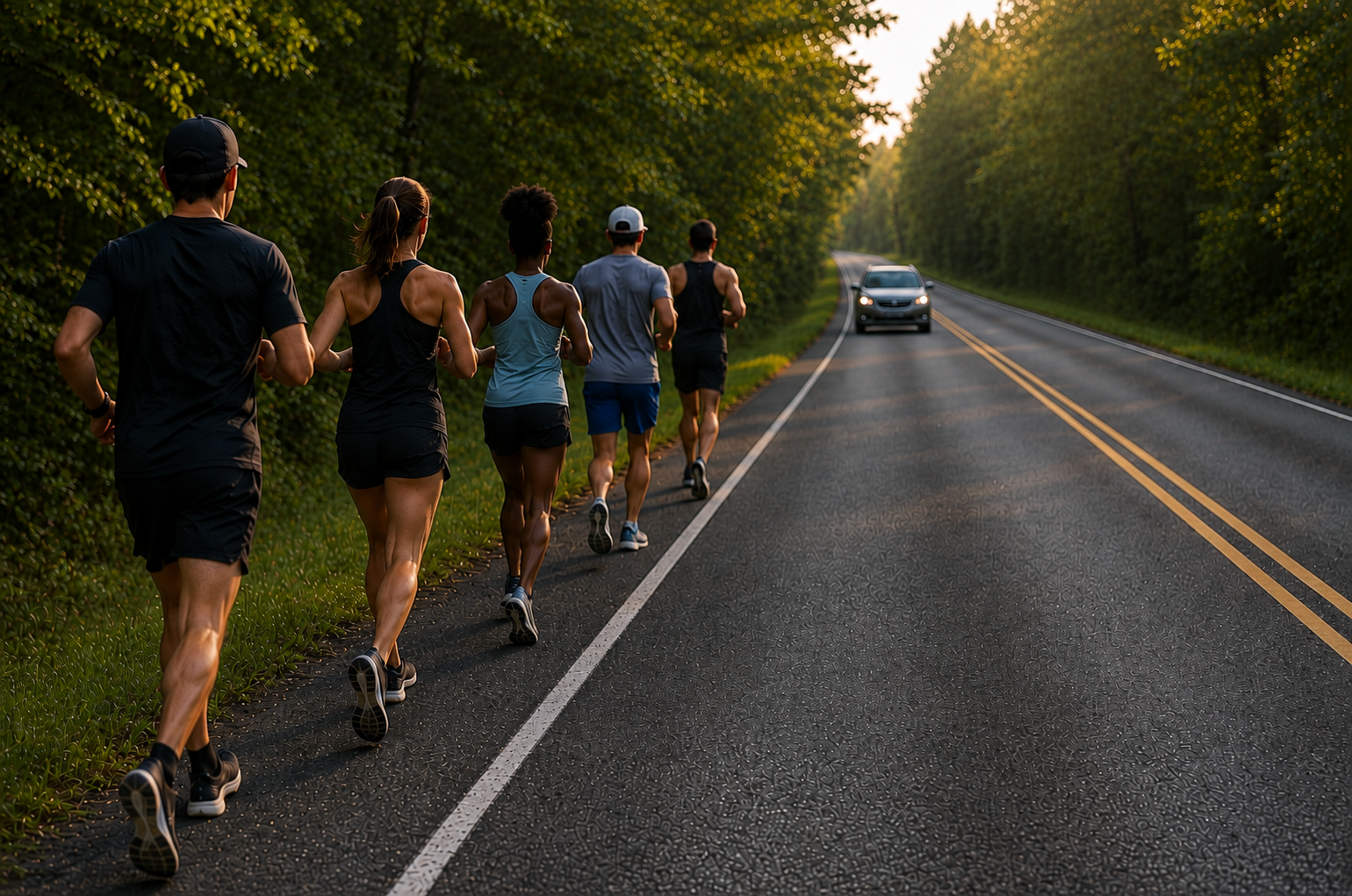
Most running injuries come from overuse. The dangerous ones come from traffic. None of this is complicated, but it's the kind of thing nobody explains until after a close call, so here it is up front.
Where you run
Run facing traffic. This is the single biggest rule. Facing oncoming cars means you can see a problem developing and react, step off, wave, whatever it takes. Run with your back to traffic and a driver has to see and adjust for you before you'd ever know something was wrong. You'd have zero warning.
Except on blind curves. If facing traffic puts you on the inside of a curve a driver can't see around, you're invisible until they're right on top of you. In that specific case, it's often safer to cross ahead of time and take the curve from the outside, even though that means running with traffic for a stretch. The goal is always visibility, and sometimes that means breaking the main rule on purpose.
Get off the road if a car is coming and there's any doubt. A near-miss isn't a fair fight. It's you against a couple thousand pounds of metal, and you lose that every time. If a driver looks like they haven't seen you, hasn't slowed down, or is drifting toward the shoulder, don't wait to find out. Step onto the grass, the sidewalk, wherever's available. Being right about who had the right of way doesn't matter if you're hurt.
Watch driveways and parking lot exits as closely as the open road. A surprising share of runner-vehicle incidents happen at these low-speed spots, not out on the highway, because drivers are looking for other cars, not for you.
Never assume you've been seen
Don't assume drivers can see you. Being in a driver's field of view isn't the same as being seen. Phones, sun glare, mirrors, and blind spots all make "they must see me" a bad bet. At an intersection or driveway, actual eye contact with the driver is the real confirmation, not just proximity.
Never run behind a vehicle that's backing up. Backup cameras and mirrors have real blind spots low and to the sides, exactly where a runner would be. This is one of the most common ways people get hit in parking lots and driveways specifically because it feels like a low-risk area.
Running in a group
Run single file when cars approach. Groups spread out naturally, which is fine until a car needs to pass on a narrow road or one with no shoulder. Collapsing to single file gives the driver the room they need and shrinks the group's footprint fast.
Be seen and be heard
Wear bright, visible gear with reflectivity. This matters most at dawn, dusk, and night, when a driver's reaction window is already shrunk by low light.
Add a blinking light in low light, not just reflective gear. Reflective material only works when a driver's headlights hit it directly. A blinking light gets noticed from angles reflective gear simply can't cover, and it catches attention before a driver's headlights are even aimed your way.
If you run with headphones, keep the volume low or use just one ear. You need to hear engines, horns, and cyclists calling out before you can see them, especially anything approaching from behind or around a corner.
Use crosswalks. Drivers are trained to expect pedestrians there. They are not expecting you mid-block, and a jaywalking runner is a genuine surprise to someone scanning the road.
What to carry
- Your phone, for calling for help or rerouting if something goes wrong.
- Pepper spray, for personal safety beyond just traffic, aggressive dogs and unwanted attention included.
- ID, or a RoadID-style tag. If something does happen, first responders need to know who you are and any medical info, fast, and you may not be able to tell them yourself.
One thing not to carry your attention on: avoid texting or scrolling while running. A phone in your pocket for emergencies is smart. A phone in your hand splitting your attention is the opposite.
Before you head out
Tell someone your route and when you expect to be back. It costs nothing and matters enormously if something goes wrong and you don't check in on time.